Problem 979
Heptagon Hopping
The hyperbolic plane, represented by the open unit disc, can be tiled by heptagons. Every tile is a hyperbolic heptagon (i.e. it has seven edges which are segments of geodesics in the hyperbolic plane) and every vertex is shared by three tiles.
Please refer to Problem 972 for some of the definitions.
The diagram below shows an illustration of this tiling.
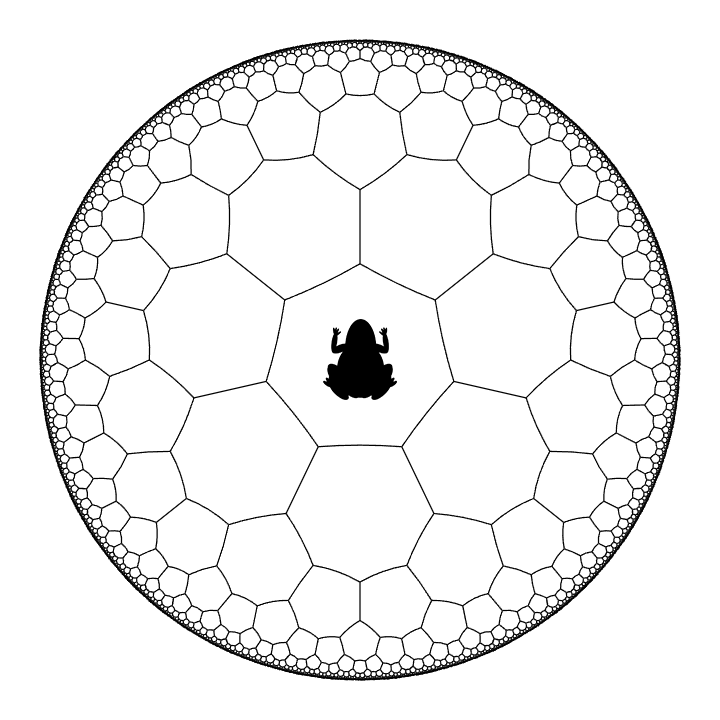
Now, a hyperbolic frog starts from one of the heptagons, as shown in the diagram. At each step, it can jump to any one of the seven adjacent tiles.
Define $F(n)$ to be the number of paths the frog can trace so that after $n$ steps it lands back at the starting tile.
You are given $F(4) = 119$.
Find $F(20)$.
七边形跳跃
由开单位圆盘表示的双曲平面可以用双曲七边形地砖密铺(双曲七边形有七条边,每条边都是双曲平面上一条测地线的一部分线段)且其中每个顶点被三块地砖共享。
部分概念的定义请参考第972题。
如下图展示了具体的密铺方式:
现在,一只双曲青蛙从如图所示的七边形出发,每一步可以跳到七块相邻地砖中的任意一块。
定义$F(n)$为青蛙经过$n$步后回到起始地砖的路径数。
已知$F(4) = 119$。
求$F(20)$。